


Preguntas Frecuentes
En esta sección encontrarás una lista de preguntas frecuentes. Si no encuentras lo que buscas, por favor no dudes en contactarnos. ¡Nos da gusto poder ayudarte de la manera que nos sea posible!

¿Sabías?
¡Aquí te cuidamos! Nuestro equipo de expertos siempre está aquí para ayudarte – listos para preguntas. Lee nuestras repuestas a continuación o llámanos al (602) 604-9500.
-
Spectrum Medical Charges on Bank Statements
Important Notice About Bank or Credit Card Charges
Spectrum Medical Care Center has recently received calls from individuals who have identified charges on their bank or credit card statements that may reference or appear to be associated with our organization. We want to clarify that these charges are not for services provided, billed, or authorized by Spectrum Medical Care Center, but instead originate from a separate, unrelated company.
If you notice this transaction on your bank or credit card statements, and you are not a Spectrum Medical Care Center patient, please contact your bank or credit card provider immediately to report and dispute the charge. Our team remains committed to transparency and is available to assist reviewing transaction details to help determine whether a charge is legitimately associated with services provided by our clinic.
Why do I see a Spectrum Medical charge on my bank or credit card statement?
If you received medical services from Spectrum Medical Care Center and paid using a bank or credit card, the charge will appear as Spectrum Medical Care CA 8011 and will include a description Spectrum Medical CA 25246853. These descriptions identify legitimate charges associated with your visit or other healthcare-related services.
Example transaction description:
SPECTRUM MEDICAL CA 8011 PHOENIX AZ
(See image example below for reference.)
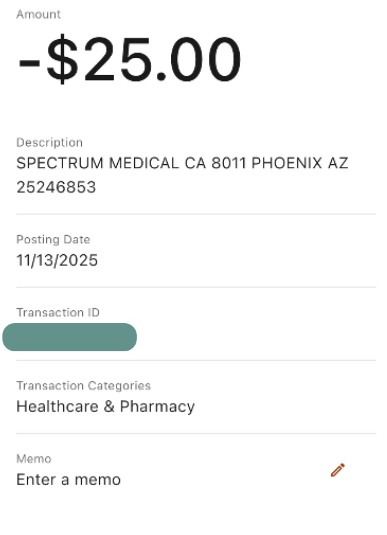
Charges may vary slightly depending on how your bank processes merchant information.
What should I do if I do not recognize a Spectrum Medical charge?
You should contact your bank or credit card company if you do not recognize the charge or do not believe you received healthcare services from Spectrum Medical Care Center.
In this situation, we recommend taking the following steps:
- Contact your bank or credit card provider immediately to report the transaction.
- Tell them you are disputing the charge.
- Your bank will guide you through the dispute process.
Can Spectrum Medical reverse or dispute the charge for me?
Unfortunately, we are not authorized to reverse, dispute, or remove charges that were not processed by our clinic. Only your bank or credit card provider can investigate and resolve unauthorized transactions on your account.
However, we are happy to help review the information with you to determine whether the charge may be connected to services provided by Spectrum Medical.
Why might someone see a Spectrum Medical charge even if they were not a patient?
In some cases, a charge may appear to reference Spectrum Medical Care Center even if no services were received from our clinic. This can occur if another merchant has incorrectly configured their payment processing system with an inaccurate or misleading business name, or if our name is being used as a decoy descriptor by an unrelated entity. These charges do not originate from Spectrum Medical Care Center and are not associated with our services.
Our Commitment to Transparency
Spectrum Medical Care Center is committed to transparency and patient trust. If you have questions about a charge that appears on your account, our team will do our best to help determine whether it is connected to services provided by our clinic.
Need Help?
If you have questions about a charge that may be connected to Spectrum Medical services, please contact our team:
Spectrum Medical Care Center
602-604-9500 -
What Insurances does Spectrum Medical Accept?
Spectrum is contracted with most of the major insurance companies, as well as Medicare and AHCCCS. It is very important that we have your current insurance information. Please report any changes in your insurance coverage as soon as possible.
Spectrum Medical Care Center is contracted with the following insurance companies:
- Aetna
- AARP UHC
- AHCCCS
- Arizona Complete Health, including Allwell, Ambetter and AZ Complete Care
- Banner Health Network and University Familycare
- Blue Cross Blue Shield of Arizona **see note below
- Cigna
- HealthChoice Arizona and HealthChoice Generations
- Humana
- Medicare
- MercyCare and MercyCare Advantage
- PHCS (Private Healthcare Systems)
- Optum Medical Network (formerly Lifeprint)
- UMR/GEHA-UMR
- United Healthcare (Commercial)
- United Healthcare Community Plan and Community Plan Advantage
Don’t see your insurance listed? We do our best to keep this information up to date, but coverage can vary by plan.
The best way to confirm your benefits is to contact your insurance provider directly. They can verify your specific plan details and confirm whether Spectrum Medical is in-network.
When you call, it may be helpful to have your insurance card and plan information available.
Spectrum Medical Care Center Tax ID: 27-0389889
Spectrum Providers’ National Provider Identification (NPI) Numbers:
Healthcare Provider NPI Number Howard Grossman, MD 1710951694 Janet Kim, MD 1215497391 M Isabel Brady, PA-C 1871586834 Kathryn Schaub, DNP, FNP-C 1538686654 Ethan Nguyen, NP-C 1821587346 Ari Kravtiz, FNP-C 1598408437 Due to claims processing and credentialing challenges, Spectrum Medical does not accept Tricare or Tricare for Life as a primary insurance.
Patients who were established with Spectrum Medical prior to January 1, 2023, are grandfathered in and may continue using Tricare or Tricare for Life as their primary insurance.
This does not apply to patients who have Medicare as their primary insurance and Tricare or Tricare for Life as secondary, which we continue to accept.
-
What is a Deductible versus Co-Insurance versus Copay?
We get it! Insurance can be confusing. Here is a list of standard insurance terms with brief descriptions to help understand your policy a little more.
- Premium: This is the amount you pay for your health insurance coverage. A premium is paid to an insurance company in exchange for their services and coverage. It can be paid monthly, quarterly, or yearly, depending on the insurance company’s requirements. A premium is separate from deductible, co-insurance or copayment amounts due for rendered care.
- Deductible: This is the amount you pay annually for healthcare services before your insurance company will pay its share. For example, if you have a $1,500 deductible for your plan, your insurance may not start to cover their share of your healthcare claims until you’ve paid $1,500. Most plans still cover the cost of preventive care visits before you have met your deductible for the year (for example – Annual Wellness Visits).
- Co-Insurance: After your deductible amount is met for the year, most health insurance plans require you to cover a percentage of your care costs. This percentage is called your co-insurance amount and is specific to your individual health insurance plan. For example, if you have a 20% co-insurance amount per your plan, that means for every $100 owed for your healthcare, you will pay $20 and your insurance will pay $80.
- Copayment (Copay): This is the amount you owe each time you receive certain types of medical care. They are specific to your individual health insurance plan and may vary depending on the kind of service – for example, you may have a $30 copay to see your Primary Care Provider, but a $50 copay to see a specialist.
- Out-of-Pocket Maximum: This is the maximum amount you will pay each year towards your healthcare, including your deductible amount, copays, and co-insurance amounts. Once you have reached your out-of-pocket maximum for the year, your insurance company should pay for the remainder of your care within that year. It is important you know the specific details for your plan. Some plans do not count extra services like acupuncture or hearing aids, or visits with Out-Of-Network providers towards your out-of-pocket maximum.
- Preauthorization: Some insurance plans require preauthorization for certain services before you receive them. Know the specifics of your plan! If this is something your plan requires, and preauthorization is not obtain prior to receiving the services, your insurance will likely not cover the charges unless it is part of emergency care.
- Health Savings Account (HSA): This is a special account that individuals can open at a bank or credit union to deposit pre-tax dollars to be used towards their medical expenses. HSA funds remain in your account until you use them. An HSA is different than a Flexible Spending Account (FSA). FSA’s follow the same concept where pre-tax dollars are held, but they are connected to your job. FSA funds must be used up before the end of the year, as they do not roll over.
- Network: An insurance network is a group of healthcare providers contracted with an insurance company to provide discounted services. They are typically made up of general physicians, as well as specialists such as dermatologists, chiropractors, oncologists, cardiologists, etc. Networks may also include laboratories. It is very important to confirm with your insurance company that the provider(s) you wish to see are In-Network or Out-of-Network with your specific plan, as this can severely impact whether or not your insurance will cover the care rendered.
- In-Network: An In-Network provider is a provider that has contracted with your insurance company.
- Out-Of-Network: An Out-of-Network provider is a provider that has not contracted with your insurance company.
- Health Maintenance Organization (HMO): HMOs are a type of managed care plan offered by most insurance companies. Most HMO’s typically have lower premiums and out-of-pocket maximums. However, HMO’s restrict members to a particular group of physicians, and will not cover your care if you see an Out-of-Network provider. If you have an HMO, you must always see your Primary Care Provider (PCP) first. If your PCP is unable to treat the problem, they can refer you to an In-Network specialist.
- Preferred Provider Organization (PPO): PPOs are a type of managed care plan offered by most insurance companies. Most PPO’s have higher premiums and out-of-pocket maximums. However, PPO’s come with more flexibility and allow members to select any physician they desire. If you have a PPO, your plan typically doesn’t require you to select a Primary Care Provider (PCP). You are generally free to see a specialist without a referral by a PCP. You are also free to see both In-Network and Out-of-Network providers. Your plan will cover more of the cost if you remain In-Network, but still offers some coverage if you go Out-of-Network.
-
What is Primary Care, and Why Do I Need It?
Primary Care is the day-to-day healthcare given by a healthcare provider. In today’s “Urgent Care” mindset, many people do not take the time to establish an on-going relationship with a Primary Care Provider (PCP). It should also be noted that a PCP does not have to be a doctor – physicians, nurse practitioners and physician assistants are all trained and capable of providing Primary Care services. Here are just 5 of the many reasons Primary Care is important. Establishing Primary Care allows you to:
- Monitor Your Health: Your PCP is there for you not only when you are sick, but also to make sure you remain healthy. Primary care includes regular checkups for early detection of chronic illnesses such as diabetes and high blood pressure. Your PCP will order annual routine screenings to check your cholesterol, blood sugar, kidney and liver function, and more.
- Manage Chronic Illnesses: Chronic illness is the leading cause of disability and death in the US. According to the CDC, 6 in 10 Americans have at least one chronic illness; and at least 4 in 10 Americans have at least two. Some of the most common chronic illnesses include diabetes, high blood pressure, arthritis, heart disease and COPD. Through an established Primary Care relationship, you can set goals to lead a healthier lifestyle and work to keep chronic illnesses under control.
- Establish a Medical Home: Having a medical home means you have a team behind you with full knowledge of your health history. Your Medical Home can help you when you’re facing an acute illness, when you need preventive care such as a physical or Annual Wellness Visit, or when you simply need a medication refill. Your Primary Care clinic will house your entire health history, including previous screenings and laboratory testing, as well as documentation from specialists’ visits.
- Provide Access to Specialists: Through understanding your “whole health,” your PCP can provide access and referrals to a wide variety of specialists that can best suit your unique and individual healthcare needs. Your Primary Care team will work to ensure the specialists have all of the medical information necessary to assist you.
- Lower Your Healthcare Costs: By seeing your PCP regularly for preventive services and screenings and maintaining open communication on your day-to-day health, you are more likely to stop serious illness from developing. Additionally, you will likely have fewer hospital and ER visits. All of this can help reduce the overall cost of your healthcare.
Spectrum Medical Care Center offers compassionate, inclusive and state-of-the-art Primary Care for the unique and individual needs of our Phoenix area LGBTQ+ community. Call us at (602) 604-9500 to schedule your appointment and make Spectrum your Medical Home today!
-
Does my Primary Care Provider Need to be A Doctor?
No. Your Primary Care Provider (PCP) does not have to be a physician. At Spectrum Medical, our physicians, nurse practitioners, and physician assistants are all highly trained and qualified to provide primary care services.
Every provider at Spectrum Medical is credentialed with the insurance plans we accept and may serve as your designated PCP. In most cases, your PCP should be the provider you see most often and feel most comfortable with throughout your healthcare journey.
-
What is a Nurse Practitioner?
If you’re unsure whether to see a Nurse Practitioner (NP) or a physician, you’re not alone. Nurse Practitioners are highly trained healthcare providers with advanced clinical education and experience who can provide many of the same primary care services as a doctor.
NPs can diagnose and treat health conditions, prescribe medications, order lab work and screenings, provide preventive care, and help manage your overall health and wellness. They also serve as Primary Care Providers (PCPs) for many patients.
At Spectrum Medical, our Nurse Practitioners are an important part of our care team and are committed to delivering compassionate, personalized healthcare designed around your needs. An added benefit? Patients can often schedule appointments with an NP sooner, helping you stay connected to care when you need it most.
-
How Do I Request a Medication Refill?
The first thing to keep in mind about medication refills is – don’t wait until the last minute! Please plan ahead. It can take up to 5 business days (not counting weekends) to complete a medication refill. Medications requiring pre-authorization may require additional time to process. If you wait until you are out of medication before requesting your refill, you may have to go without your medication for several days while we complete the refill process. Please also plan ahead for any refills that may be needed during holidays or while traveling.
The first step in requesting a refill is to check your prescription label on the bottle or box. It should say “refills” with a number next to it and a date by which you must refill. If this number is greater than 0, you simply need to call your pharmacy to request your refill.
If the refill number is 0, or there are no refills listed on your label, you will need to contact our office. Please call (602) 604-9500 and speak with our Customer Service Team to get the refill process started. Please ensure we have the most up-to-date insurance and pharmacy information to avoid any additional delays!
-
What is an Annual Wellness Visit (AWV) and Why Do I Need One?
One of the best ways to take control of your health is to see your provider for an Annual Wellness Visit (AWV). An AWV is NOT a physical exam. Instead, it is a preventive exam that takes place when you’re feeling healthy and well. Taking the time for a yearly AWV helps your provider understand what is working for you and how to best support your continued health and well-being. During an AWV you can work with your provider to create or update a personalized prevention plan based on your current health and risk factors.
For those patients on Medicare Part B (Medical Insurance) for longer than 12 months, a yearly “Wellness Visit” is typically included as part of your coverage. Medicare encourages these preventive visits as a way to help prevent disease or disability. Your Part B deductible does not apply, however, you may have to pay co-insurance amount if additional tests or services are performed during the same visit which are not covered by Medicare in a preventive visit setting – for example a wart removal would not be included as part of a Wellness Visit. For more information regarding the Medicare Annual Wellness Visit, please visit https://www.medicare.gov/coverage/yearly-wellness-visits.
-
How Do I Request my Medical Records?
Only you or your appointed representative(s) has the right to access your medical records. Obtaining copies of your medical records for yourself from Spectrum Medical can be handled through our Patient Portal or by calling our office at (602) 604-9500 and requesting our Medical Records department. If you are requesting medical records be provided to another individual or provider’s office, you will need to complete and return to us a Release of Information form.
-
What is a Patient Portal and Why Should I Sign Up?
Patient portals allow for greater communication between providers and their patients. By signing up for Spectrum’s patient portal, you will have easy access to your health information. Some of the other key portal capabilities include:
- View After Visit Summaries
- View your Medication List and Request Medication Refills
- View and Print your Patient Statements and Pay Your Bill
- View Lab Results
- Join a Televisit
- View Important Patient Documents
- Request your Medical Records
- Send a Message to the Clinic
Call us at (602) 604-9500 to request Portal Access today! Once your request is completed, you can easily access our patient portal here from our website – just click on the “patient login” button near the top of the page.